
The concept of the "uncanny valley" refers to the feeling of unease we experience when interacting with artificial entities that closely resemble human beings, but not quite enough to be considered fully human. This theory, proposed by Japanese roboticist Masahiro Mori in 1970, suggests that our empathy toward robots increases as they become more human in appearance and behavior, until they reach a point where their near-perfect resemblance provokes repulsion and disquiet.
Sesame: A New Frontier in the Humanization of Artificial Voices
One of the most advanced projects in generating synthetic voices is Sesame , an AI platform that has developed technology to cross the "uncanny valley" in the realm of digital speech. The company has worked to improve the expressiveness and naturalness of AI-generated voices, allowing them to mimic emotional tones, natural pauses, and variations in intonation that make communication sound more authentic.
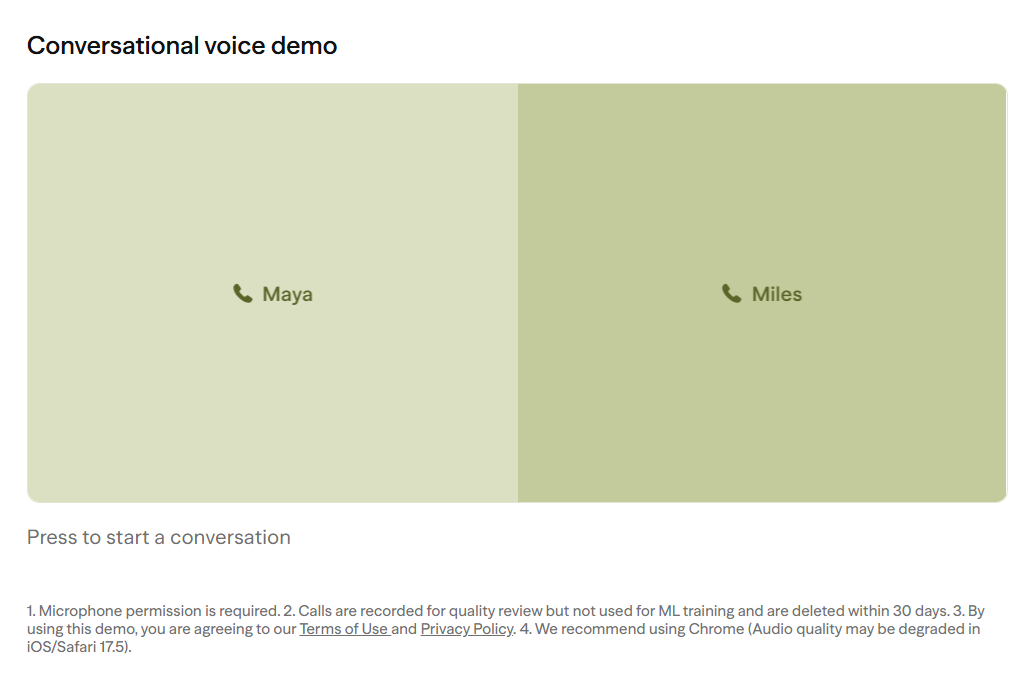
To demonstrate its progress, Sesame has launched an interactive demo that allows users to modify different parameters of the AI-generated voice, adjusting its warmth, speed, and emotion. This experiment reveals how certain adjustments make the synthetic voice sound more human, while others can create a disturbing or artificial feel. This research reinforces the idea that the perception of naturalness in an artificial voice depends not only on its timbre but also on the consistency of its cadence, rhythm, and emotional intent.
Communication between AI agents has advanced significantly, exploring more efficient and natural methods. Recently, a video went viral showing two AI assistants communicating using sounds similar to an old modem or the beeps of droids from Star Wars. While this method of communication is more efficient than the human voice, AI experts point out that it is impractical and that it would be more efficient for AIs to communicate via text.
Examples of the Use of Artificial Voices Today
- Virtual Assistants : Platforms like Amazon's Alexa and Google Assistant use advanced synthetic voices to interact with users, offering natural and contextually relevant responses.
- Customer Service Systems : Companies are implementing chatbots and interactive voice response (IVR) systems powered by conversational AI to handle common inquiries, improving operational efficiency and the customer experience.
- Content Reading : Text-to-speech conversion tools allow the automated reading of articles, books, and other content, facilitating access to information for people with visual impairments or reading difficulties.
Ethical Considerations and the Future of Artificial Voice
As artificial voices become indistinguishable from human voices, ethical and social challenges arise. The possibility of synthetic voices replacing voice actors and announcers has generated concern in the industry, leading to debates about labor rights and intellectual property. Furthermore, AI's ability to generate realistic audio content raises risks related to disinformation and fraud.
It is crucial to establish regulations that require AIs to identify themselves as such at the beginning of a conversation, ensuring transparency and trust in human-machine interactions.
In conclusion, the evolution of artificial voice technology brings us closer to more natural and efficient communication with machines. However, it is essential to address the challenges associated with the uncanny valley and the ethical implications of these technologies to ensure their harmonious integration into our society.