
Imagine having a conversation with an AI that truly seems to understand you. It not only responds accurately, but also knows when to offer advice and when to simply listen. This is GPT-4.5, the new version of OpenAI's language model that promises more intuitive, natural, and safe interactions . But what's really new? Let's find out.
Broader knowledge and more refined intelligence
GPT-4.5 expands its capabilities beyond solving problems in science and technology, encompassing a diverse range of subjects with a richer understanding. The main improvement lies in its ability to avoid misinterpretations and minimize so-called "hallucinations" or incorrect responses in everyday tasks. Now, the model not only processes data more accurately but also contextualizes it in a more human-like way.
This translates into more coherent, better-organized responses with a lower degree of uncertainty. While GPT-4 could previously be wrong about specific details, GPT-4.5 now demonstrates superior reliability in handling complex and nuanced information.
Empathy and understanding of human intention
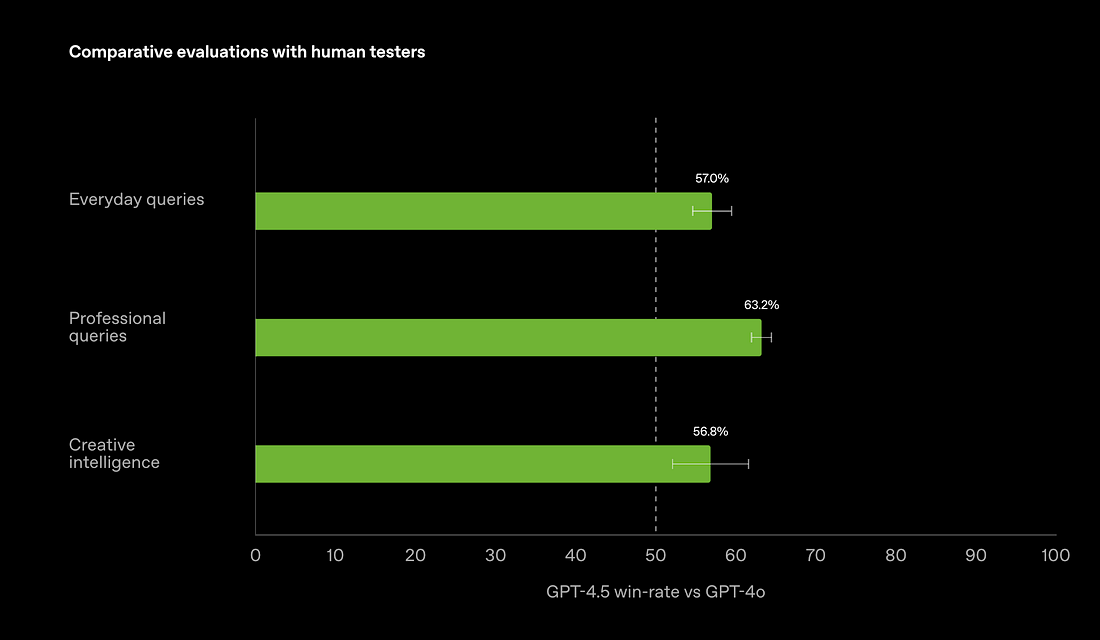
One of the most exciting advances is its refined ability to align with human intention. Through new training techniques, such as Supervised Fine-Tuning (SFT) and Human Feedback Reinforcement Learning (HFRL), the model has been taught to recognize not only what is said, but how and why it is said.
In internal testing, testers have reported that GPT-4.5 "knows when to give advice and when to simply listen." This level of emotional understanding is a significant step forward in human-machine interaction. The AI can now modulate its tone, adapt to the context of the conversation, and avoid generic or inappropriate responses.
Greater security and resistance against attacks
Security remains a key focus in the evolution of OpenAI models, and GPT-4.5 is no exception. Rigorous assessments have been conducted to strengthen its resilience against prohibited content, breach attempts, and potential biases.
The model has been jailbroken (using techniques to circumvent AI restrictions) and its ability to reject dangerous requests has been shown to be comparable to that of GPT-4o , its predecessor. While no model is infallible, the rate of inappropriate or biased responses has been significantly reduced.
However, within OpenAI's assessment framework, it is classified as having a "medium risk" in sensitive areas such as CBRN (chemical, biological, radiological, and nuclear) advice and persuasion. Despite this, it does not exhibit significantly superior capabilities in autonomy or self-learning compared to previous models.
Improved performance across multiple languages
The language barrier is further reduced with GPT-4.5. Its performance on multilingual tasks has improved, outperforming GPT-4.0 in tests such as adherence to permitted content, accuracy in PersonQA, and performance on the MMLU multilingual assessment.
For those who interact in multiple languages, this means smoother and more accurate communication across a variety of contexts. Whether it's a casual conversation, a technical query, or a translation, GPT-4.5 offers a much more natural and effective experience.
Gradual deployment and a look to the future
OpenAI is approaching the implementation of GPT-4.5 as a "research preview," allowing users and experts to provide feedback on its real-world performance. This process aims to refine rejection thresholds, improve alignment with more domains, and monitor for potential misuse.
While this version represents a leap forward in accuracy, security, and empathy, OpenAI makes it clear that the evolution of its models doesn't stop here. On the horizon lies an increasingly collaborative AI that not only answers questions but also offers meaningful support in people's daily lives.
The future of AI interactions
In short, GPT-4.5 marks a milestone in the evolution of language models. It's not just a more powerful model , but one that truly seeks to understand and support those who interact with it. With improved linguistic skills, greater security, and emotionally intelligent responsiveness, the future of artificial intelligence is shaping up to be a more useful, human, and reliable tool. A model we should incorporate into our AI Expert .
The question isn't whether these improvements will make AI more popular, but how they will change the way we interact with it in the coming years. Are you ready to meet your new trusted AI?
